Why We Built a Token-Based Platform
Most platforms treat infrastructure like a meter running quietly in the background.
The more your experience grows, the more services activate underneath it:
- streaming,
- storage,
- runtime systems,
- synchronization,
- networking,
- asset delivery,
- real-time orchestration.
And eventually, a bill appears.
For creators building interactive experiences, that model can become frustrating very quickly.
Success starts feeling risky.
Growth becomes unpredictable.
And scaling infrastructure can feel disconnected from the actual creative process.
GEM was designed differently.
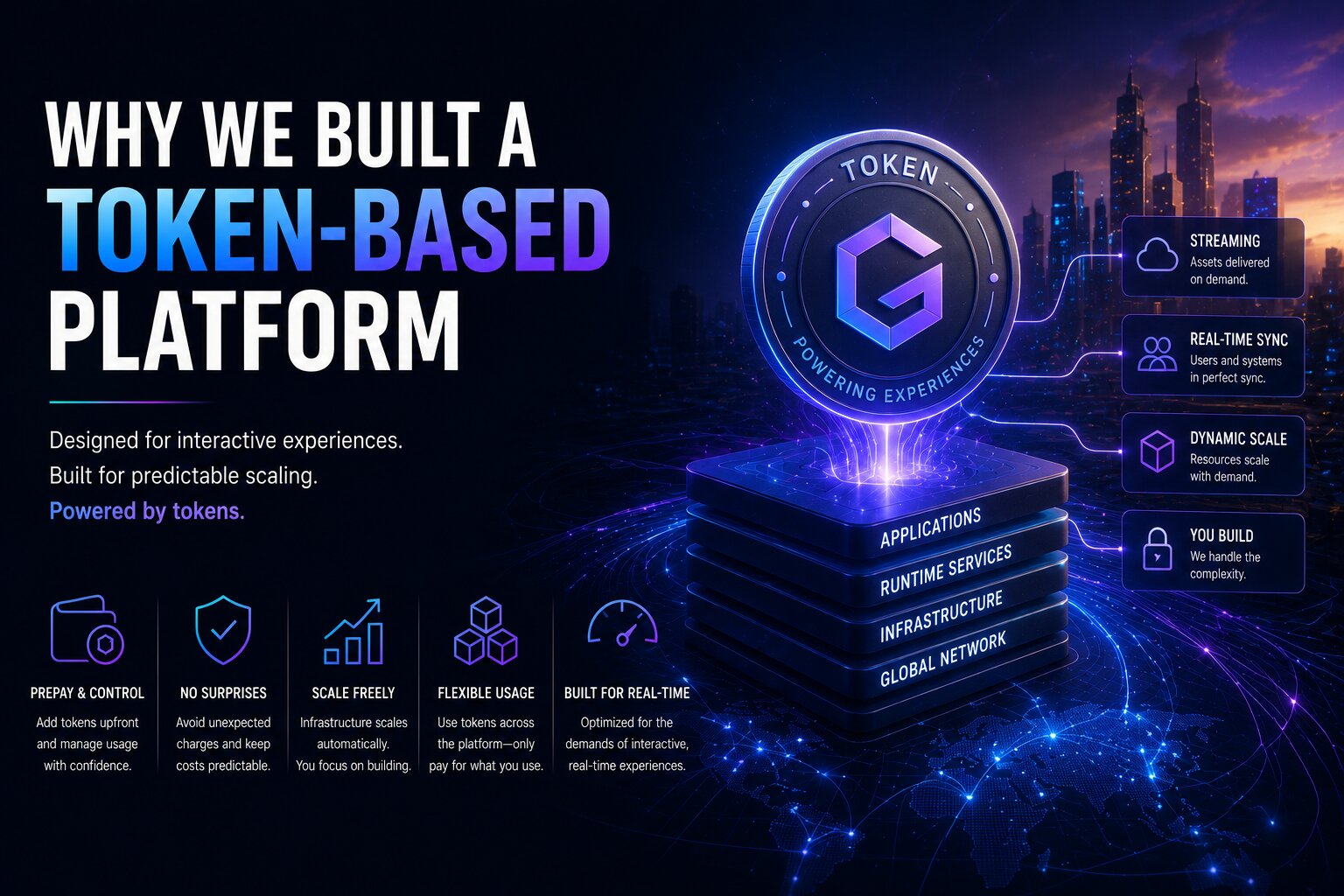
Instead of relying entirely on traditional subscription or surprise usage billing, GEM uses a token-based system built around flexibility, visibility, and scalable experiences.
Built Around Growth
Interactive platforms are unpredictable by nature.
One day a project may be quiet.
The next it may suddenly:
- stream large environments,
- support live events,
- process thousands of interactions,
- or scale across multiple active users simultaneously.
Traditional fixed pricing doesn’t always map cleanly to systems like that.
A token model allows platform resources to scale more naturally alongside the experience itself.
As projects grow, the infrastructure supporting them can grow too — without forcing every creator into the same rigid structure.
Prepay Instead of React
One of the biggest reasons behind the token system is simple:
control.
Instead of worrying about unexpected charges appearing automatically after traffic spikes or scaling events, creators can preload platform usage ahead of time.
That means:
- fewer surprises,
- clearer limits,
- easier budgeting,
- and more confidence when experimenting.
The goal isn’t to create friction.
It’s to remove uncertainty.
Infrastructure Is Part of the Platform
Interactive experiences require a tremendous amount of infrastructure underneath them.
Not just servers —
but systems continuously coordinating:
- assets,
- streaming,
- events,
- runtime communication,
- storage,
- synchronization,
- and distributed services.
GEM handles much of that complexity behind the scenes.
The token system helps support infrastructure that can scale dynamically while remaining manageable for creators building on the platform.
Instead of forcing developers to constantly engineer operational layers themselves, GEM is designed to absorb much of that complexity into the platform architecture.
Better for Experimentation
Creative development rarely follows a straight line.
Projects evolve.
Ideas change.
Experiences scale unexpectedly.
A token-based model creates more flexibility for experimentation because creators aren’t immediately locked into oversized plans or unpredictable infrastructure costs.
You can prototype.
Test ideas.
Launch worlds.
Scale experiences.
And grow usage over time more organically.
Designed for Real-Time Platforms
Traditional billing systems were mostly built for traditional software.
But interactive environments behave differently.
Usage fluctuates constantly.
Systems activate dynamically.
Services scale in real time.
Experiences evolve continuously.
GEM’s token system was designed around those realities from the beginning.
Not simply as a payment model —
but as part of building a platform designed for live, scalable, interactive systems.
Scaling Shouldn’t Feel Punishing
One of the ideas behind GEM is that creators shouldn’t fear success.
If an experience suddenly grows, the platform should help support that growth — not make it feel dangerous or unpredictable.
The token system exists to make scaling feel more intentional, transparent, and manageable as projects evolve.
Because building immersive experiences is already complicated enough.
Infrastructure shouldn’t make it harder.