Accessibility Matters More Than Most People Think
When people talk about immersive technology, the conversation usually focuses on graphics first.
Better rendering.
More polygons.
Higher fidelity.
Bigger worlds.
More visual realism.
And while visuals absolutely matter, they are only part of the experience.
Because even the most impressive environment in the world means very little if people struggle to access it in the first place.
That’s something the industry has wrestled with for years.
Downloads.
Installers.
Large client updates.
Platform restrictions.
Hardware limitations.
Compatibility issues.
Before users even reach the experience itself, friction often gets in the way.
GEM was built with a different philosophy:
sometimes accessibility matters more than graphics.
The Power of Instant Access
The browser remains one of the most accessible platforms ever created.
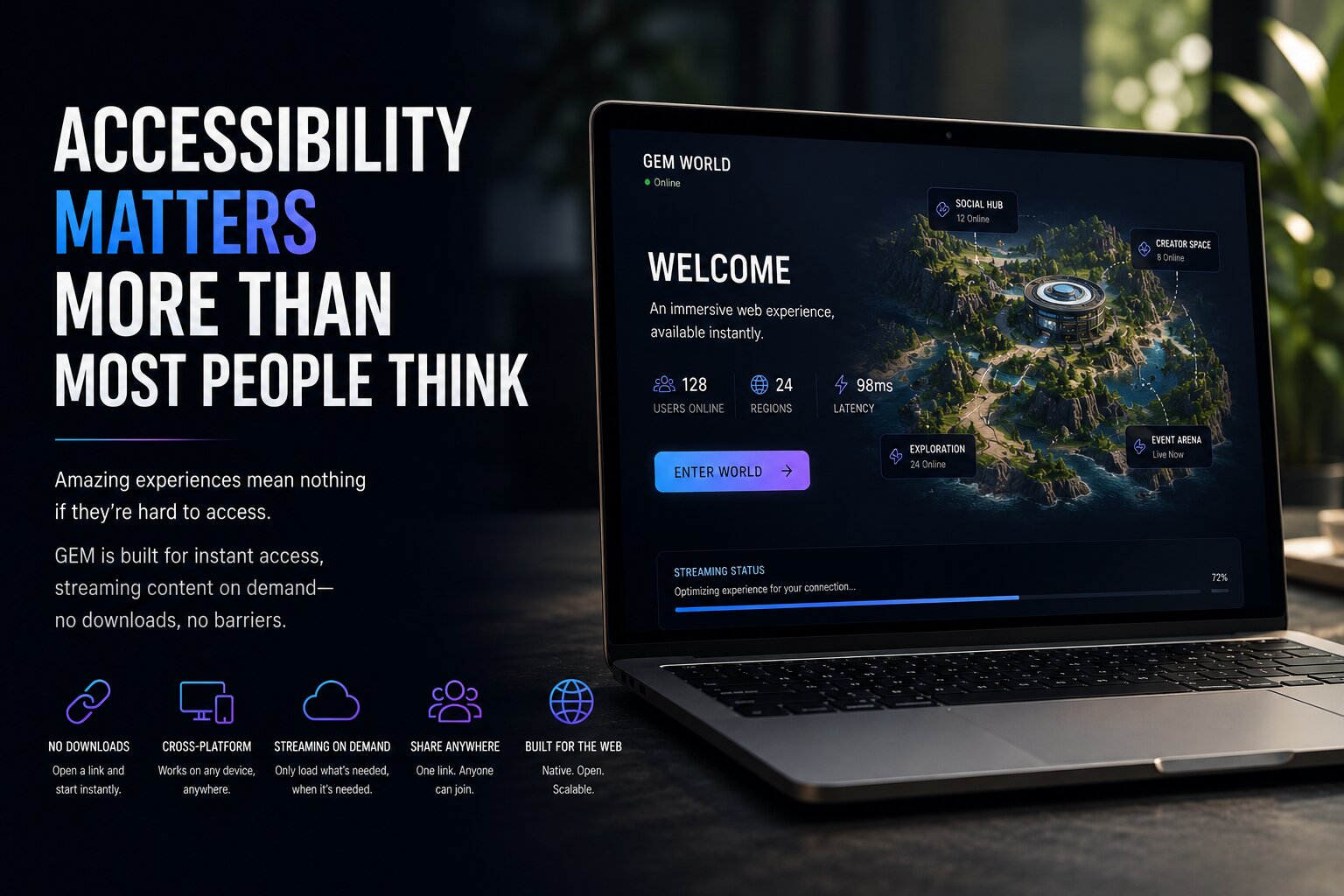
A single link can open an experience instantly across devices, operating systems, and locations without requiring users to install massive applications beforehand.
That changes how people interact with immersive systems.
Experiences become easier to:
- share,
- discover,
- test,
- collaborate in,
- and return to.
The less friction between curiosity and interaction, the larger the potential audience becomes.
Streaming Changes the Experience
Traditional applications often require downloading everything upfront:
- environments,
- textures,
- assets,
- audio,
- and runtime systems.
But modern browsers and cloud infrastructure allow a different approach:
streaming content dynamically as it’s needed.
GEM is designed around this idea.
Instead of forcing users to install an entire world before entering it, environments can stream progressively while systems load intelligently in the background.
Scenes can evolve in real time.
Assets can load on demand.
Experiences can become more responsive and scalable without feeling heavy or disconnected from the web itself.
Accessibility Is About More Than Devices
Accessibility isn’t only about supporting multiple platforms.
It’s also about reducing barriers.
The easier an experience is to access, the more naturally it becomes part of everyday interaction.
A browser-based platform removes many of the traditional obstacles that prevent immersive applications from reaching wider audiences:
- long installations,
- app store limitations,
- operating system restrictions,
- and update fragmentation.
The experience becomes immediate.
And immediate experiences tend to get explored.
The Browser Is Becoming a Real Runtime
Modern browsers are no longer simple document viewers.
They now support:
- hardware-accelerated rendering,
- real-time networking,
- streaming assets,
- persistent storage,
- multithreading,
- advanced graphics APIs,
- and increasingly sophisticated runtime systems.
The browser is evolving into a capable platform for interactive worlds and applications.
Not a limitation —
but a foundation.
Building for Reach
One of the goals behind GEM is making immersive experiences more approachable to both creators and users.
Not everyone wants to install a multi-gigabyte application just to explore a world for a few minutes.
Sometimes the best experience is the one people can access immediately.
A link.
A browser.
And the experience begins.
Beyond Graphics
Graphics will continue improving.
Rendering technology will continue evolving.
But accessibility may ultimately shape which platforms and experiences actually grow.
Because the experiences people remember are often the ones they could simply open, explore, and share without barriers getting in the way.
And that’s one of the most important ideas behind GEM:
immersive experiences should feel native to the web itself.