
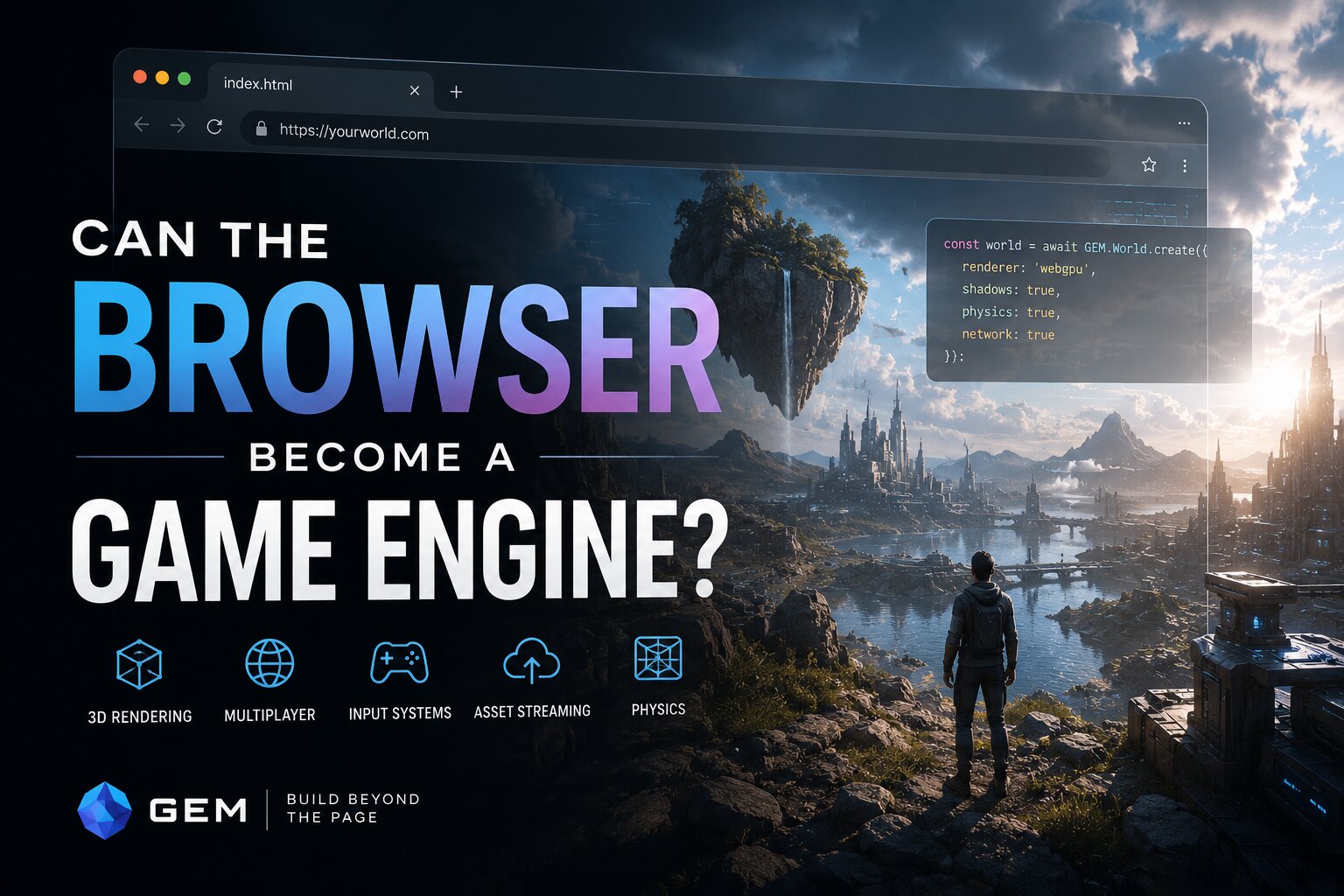
Can the Browser Become a Game Engine?
For a long time, the browser was treated like a document viewer.
Websites were pages. Interfaces were mostly static. Interactivity was limited to forms, animations, videos, and lightweight applications. If you wanted to build something immersive — a game, simulation, virtual environment, or real-time interactive world — you typically left the browser behind and moved into native engines and desktop runtimes.
But the web has changed.
Modern browsers now contain technologies that would have sounded unrealistic a decade ago:
- hardware-accelerated 3D rendering,
- real-time networking,
- advanced GPU pipelines,
- spatial audio,
- streaming assets,
- persistent storage,
- multithreading,
- low-latency input systems,
- and increasingly powerful graphics APIs like WebGPU.
The browser is no longer just displaying content.
It’s becoming a runtime.
More Than Websites
Today, browsers are capable of rendering cinematic scenes, interactive environments, multiplayer systems, and large-scale applications directly on the web.
You can launch immersive experiences instantly through a URL.
No installer.
No platform restrictions.
No app store approval process.
That accessibility changes everything.
The web has always been the most open software platform in the world. If immersive systems can fully exist inside the browser, then the barrier between “website” and “application” starts disappearing entirely.
So… Can It Really Become a Game Engine?
In many ways, it already has.
Modern web engines can handle:
- real-time 3D rendering,
- physics,
- animation systems,
- asset streaming,
- multiplayer synchronization,
- procedural environments,
- input management,
- UI systems,
- audio pipelines,
- and increasingly complex runtime logic.
But raw rendering capability isn’t the hardest part anymore.
The real challenge is tooling.
Building immersive web experiences still often requires developers to wire together dozens of disconnected systems:
- rendering frameworks,
- editors,
- asset pipelines,
- scene management,
- deployment systems,
- runtime infrastructure,
- interaction logic,
- and collaborative tooling.
That complexity is part of what led to GEM.
The Browser’s Biggest Advantage
Traditional game engines are powerful, but the browser has one advantage they can never fully replicate:
instant access.
A browser experience can be shared with a link.
Opened on nearly any device.
Updated globally in real time.
Integrated directly into the fabric of the internet.
That changes how experiences can be built, distributed, and interacted with.
The future may not be websites or game engines.
It may be something in between.
Interactive worlds that are:
- accessible like websites,
- immersive like games,
- collaborative like online platforms,
- and extensible like software ecosystems.
The Missing Layer
The browser is powerful enough.
What’s still evolving is the layer between the raw technology and the creator.
That’s where platforms like GEM are focused:
making immersive web development more practical, scalable, and approachable without sacrificing flexibility.
Not replacing creativity.
Not replacing developers.
But reducing the amount of infrastructure every project has to rebuild from scratch.
What Comes Next
As browsers continue evolving, the line between applications, games, virtual environments, and websites will keep blurring.
The web is moving from pages to systems.
From interfaces to experiences.
From static content to living environments.
The browser may never look exactly like a traditional game engine.
But it may become something even more interesting:
a universal runtime for interactive worlds.