What Is the Autobahn?
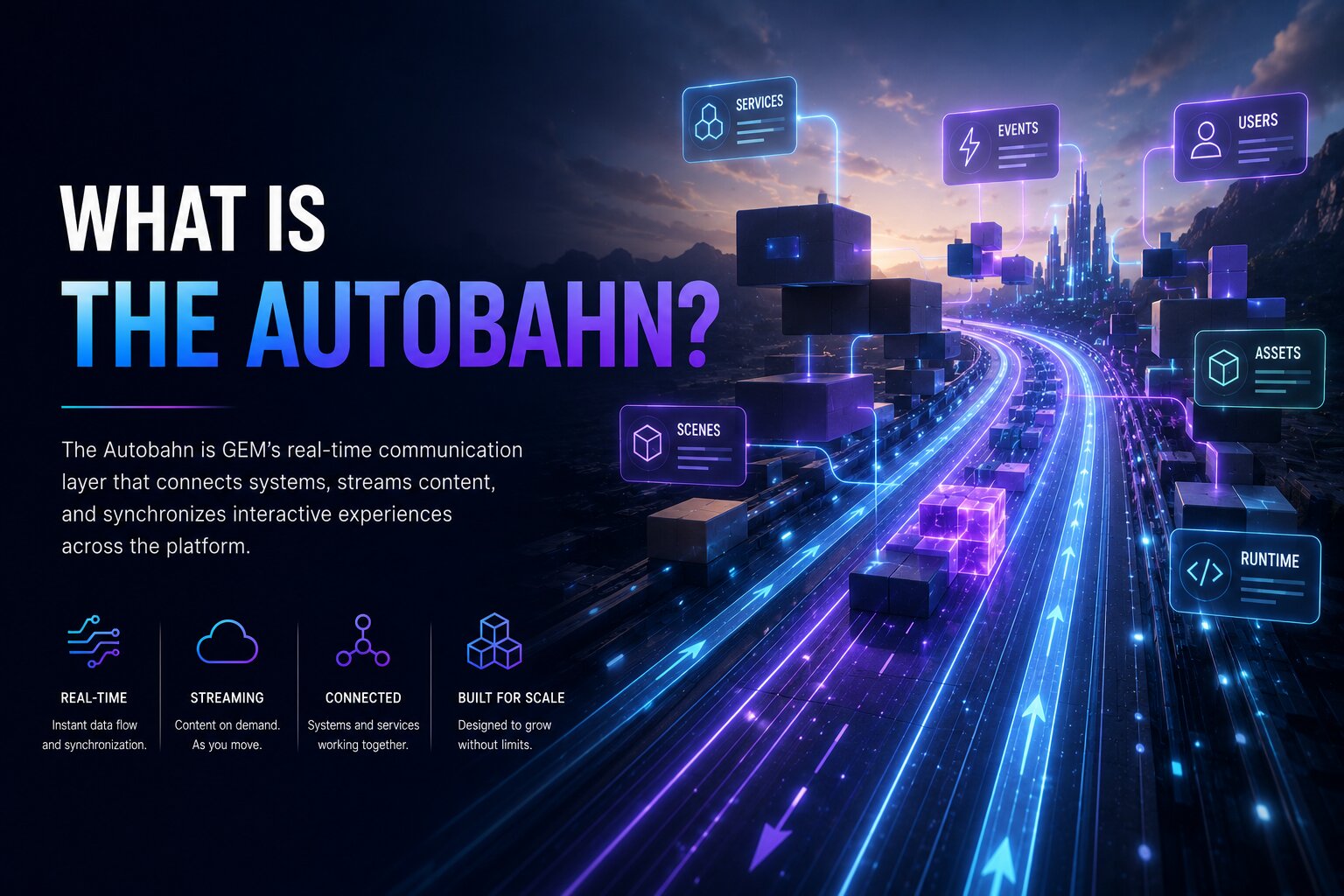
Every interactive experience needs a way for systems to move information efficiently. Assets stream, scenes synchronize, events propagate, users interact in real time, and services communicate underneath the experience.
As immersive environments become larger and more connected, data movement becomes as important as rendering. That is where the Autobahn comes in.
More Than a Network Layer
The Autobahn is a core concept behind GEM's real-time architecture. At a high level, it acts as a high-speed communication and synchronization layer between systems, services, runtimes, and interactive experiences across the platform.
Instead of isolated systems constantly polling or operating alone, the Autobahn is designed to let information move fluidly in real time. Think of it less like a single API and more like a connected runtime highway for live systems.
Built for Real-Time Experiences
Traditional pages load content, wait for interaction, make occasional requests, and refresh state periodically. Interactive worlds need constant movement: live events, synchronized users, streaming updates, runtime changes, environmental reactions, multiplayer systems, and distributed services working together.
The Autobahn is designed around those needs.
Streaming the World
One of the Autobahn's primary goals is supporting dynamic, on-demand experiences. As users move through environments, systems can stream assets progressively, synchronize scene updates, distribute runtime events, and coordinate services in real time.
Instead of forcing massive upfront downloads, environments can evolve continuously while users interact with them. The result is an experience that feels more alive and responsive.
Connecting Systems Together
Modern interactive platforms are made of many systems: scene services, runtime orchestration, asset management, user systems, AI systems, event pipelines, communication layers, and deployment infrastructure.
The Autobahn helps these pieces communicate without tightly coupling everything together. Services can stay modular while still participating in a shared real-time ecosystem.
Real-Time Synchronization
As collaborative and multiplayer experiences become more common, synchronization becomes critical. Users need to see updates instantly, interact with live systems, collaborate inside environments, and experience shared worlds consistently.
The goal is to move state changes and runtime events quickly throughout the platform while maintaining scalability.
Designed for Scale
Real-time systems become more complex as environments grow. More users, scenes, events, assets, and synchronization all create pressure on the infrastructure underneath the experience.
The Autobahn is being designed with scalability in mind from the beginning, so experiences can expand without requiring a completely different architecture later.
Infrastructure for Living Systems
One idea behind GEM is that interactive experiences are becoming less like static applications and more like living systems: persistent environments, continuous interaction, streaming content, shared experiences, and runtime evolution.
The Autobahn supports that future by moving information, events, and experiences fluidly throughout the platform in real time.
The Road Ahead
The browser is evolving quickly. Interactive environments are getting larger. Real-time systems are becoming expected.
As the web shifts toward immersive experiences, the infrastructure underneath those experiences becomes increasingly important. The Autobahn is one part of that foundation: mostly invisible to users, but essential to making interactive worlds feel connected, responsive, and alive.