
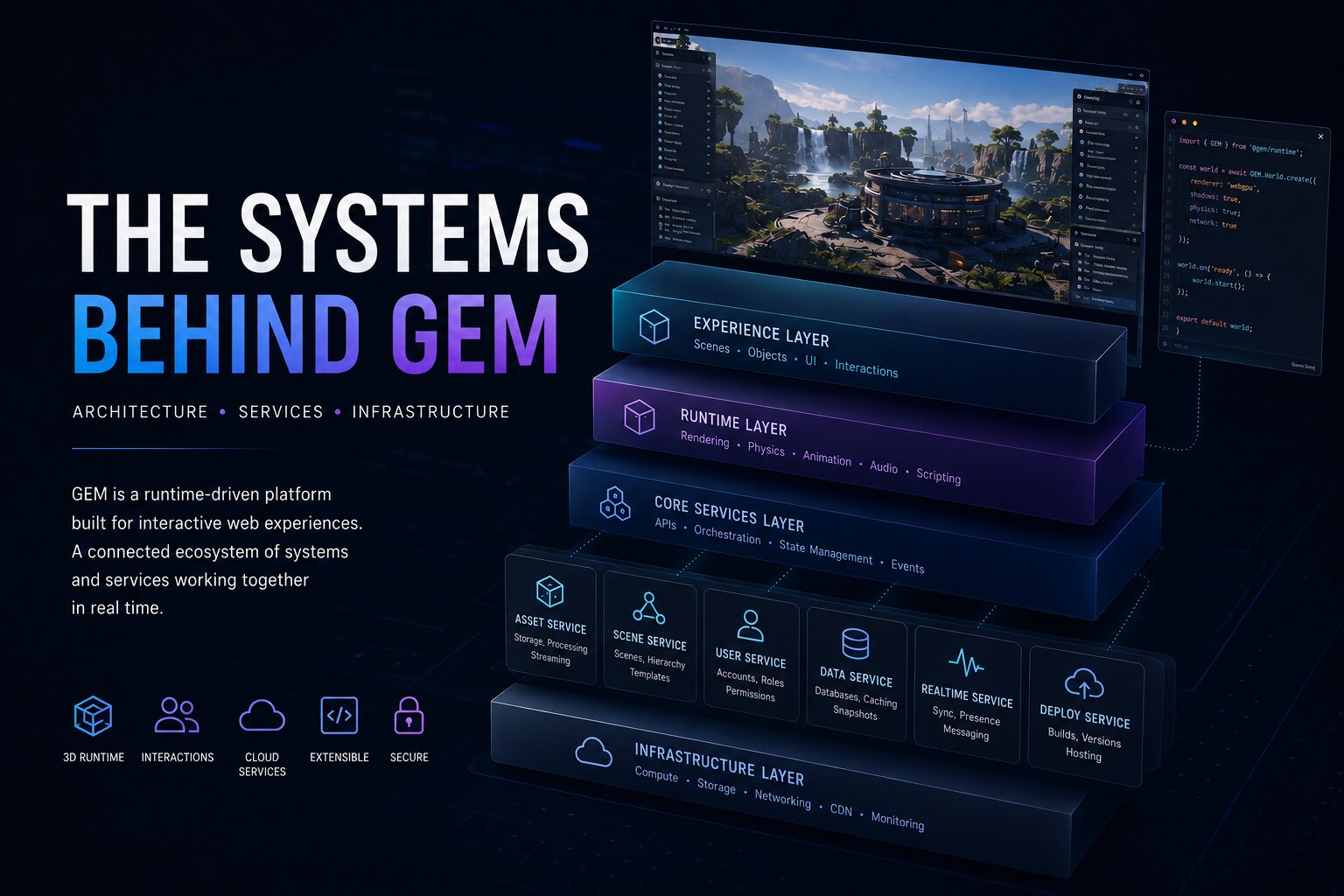
The Architecture and Services Behind GEM
Interactive experiences may look simple, but underneath is a network of systems working together in real time: rendering, assets, synchronization, storage, streaming, APIs, workers, state, and infrastructure.
GEM was built around the idea that immersive web experiences need more than graphics. They need architecture designed for interactive systems operating at scale.
A Runtime-Driven Platform
At its core, GEM is a runtime-driven platform. Instead of treating projects like isolated pages, GEM treats them as living environments made from connected scenes, assets, services, interaction layers, and orchestration pipelines.
Each system is designed to work in real time while staying modular enough to evolve independently.
Scene Architecture
Scenes are foundational to GEM. A scene is more than visual data. It can contain objects, transforms, environments, lighting, behaviors, triggers, events, and interaction systems.
This structure allows GEM to support simple experiences and larger interactive worlds without changing how projects are organized underneath.
Asset Services
Immersive applications depend on models, textures, materials, animations, audio, effects, and environmental data.
GEM uses asset services to organize, optimize, stream, cache, and distribute runtime content across projects and scenes. The goal is to make large browser-based environments practical without forcing developers to rebuild every asset pipeline themselves.
Runtime Services
GEM's runtime layer coordinates live systems during execution. It supports object synchronization, event processing, interaction handling, state updates, scene communication, and runtime orchestration.
As environments become more interactive, these systems need to communicate continuously while staying responsive and scalable.
Event and Interaction Systems
Interactive environments are event-driven. Objects respond to users, systems respond to runtime state, and scenes respond to live activity.
GEM uses event-based architecture so systems can react dynamically without tightly coupling every component together. This makes it possible to build reactive environments, automated systems, broadcasts, synchronized interactions, and persistent behaviors.
API and Service Layer
Under the visual layer, GEM relies on APIs and service orchestration for project management, runtime configuration, scene persistence, user systems, deployment workflows, storage, and asset delivery.
This separation allows services to scale independently and evolve without requiring the entire runtime to be rebuilt.
Infrastructure and Scale
Interactive environments introduce different infrastructure challenges than traditional websites. Real-time systems need low-latency communication, distributed asset delivery, scalable execution, efficient caching, and responsive synchronization.
GEM's architecture is designed with scale in mind so projects can grow beyond prototypes into larger interactive environments.
Building Systems Instead of Rebuilding Them
One motivation behind GEM was seeing how often immersive projects rebuild the same infrastructure: scene systems, asset pipelines, runtime orchestration, interaction layers, and deployment architecture.
GEM reduces that repetition by giving creators and developers a foundation for building experiences instead of rebuilding the same systems over and over.
What Comes Next
The browser is becoming a capable runtime for interactive applications, environments, and digital worlds.
The future of immersive web experiences will depend on systems design as much as rendering. GEM is being built for that future: modular, scalable, interactive, and designed for experiences far beyond the traditional web page.