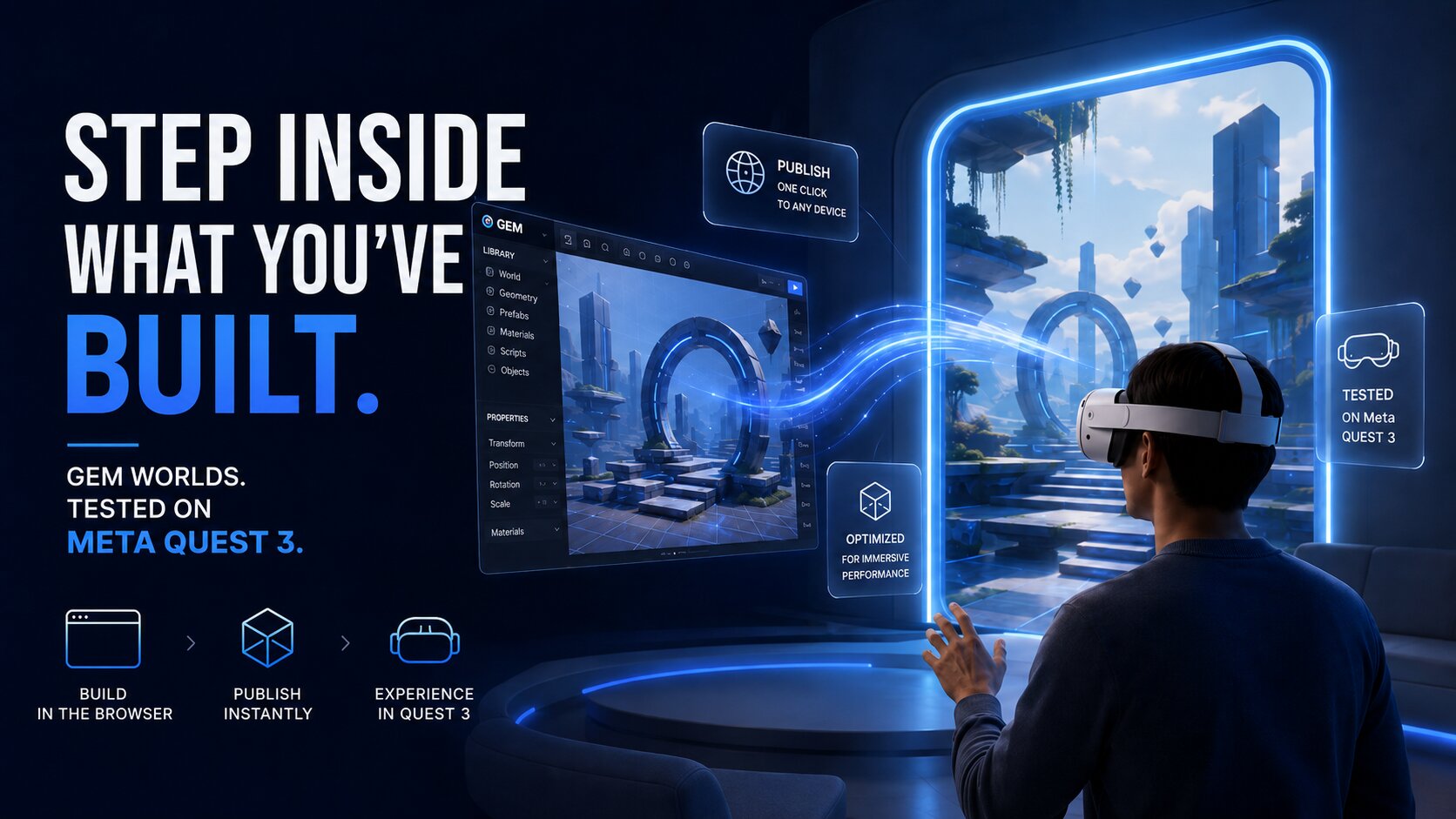
Step Inside What You’ve Built.
Tested on Meta Quest 3: GEM in VR is not a science-fiction demo. It is the natural next step for the scenes people are already building: a world that can open on a laptop, on a phone, on a website, and on a WebXR-capable headset.
That is the headline worth getting excited about: what you create on GEM can be accessed on any WebXR-capable VR headset. You build the world once. GEM publishes it through the web. Visitors enter from the device they have in front of them.
On a desktop, a GEM project is a rich 3D scene. On mobile, it is a navigable interactive space. In a headset, it becomes something more powerful: a place.
The Moment That Changes The Pitch
When a GEM scene opens inside a headset, the story changes immediately. You are no longer only showing someone a product, a venue, a classroom, a portfolio, a brand, or an idea. You are inviting them to stand inside it.
That matters because VR changes what people remember. Scale becomes real. Distance becomes real. The sound of a scene, the placement of an object, the path through a room, the moment someone turns and notices a detail behind them - all of that becomes part of the experience.
In Meta Quest 3 testing, the most exciting thing was how natural the GEM model feels in a headset. GEM scenes are already spatial. They already have cameras, lights, meshes, materials, sounds, assets, and scene state. VR is not a separate idea bolted onto the side. It is a deeper way to experience the same world.
Why The Web Matters For VR
The practical magic is WebXR. WebXR is the browser technology that lets web experiences enter augmented and virtual reality when the device supports it. Meta Quest Browser is built on Chromium and optimized for WebXR and WebGL, which makes the Quest family a natural place to test browser-based immersive worlds.
For creators, this is a big shift. Instead of treating every headset like a separate app-store project, GEM can use the web as the doorway. A visitor can discover a scene, open it in a compatible browser, and enter VR when the project and device are ready for it.
That does not mean every headset, browser, and scene behaves identically. VR still depends on device support, browser support, scene complexity, network conditions, and good optimization. But the direction is clear: the immersive web is becoming a real distribution path, and GEM is built for exactly that kind of future.
How GEM Makes It Work
GEM starts with the builder. Creators can shape scenes with models, terrain, materials, lights, water, sounds, settings, and uploaded assets. Those scenes are then published through GEM's hosted runtime, which loads the correct project configuration and scene version for the visitor.
When XR is enabled for a project and the browser supports it, GEM can request VR/XR mode through the scene runtime. The developer-facing API is intentionally simple:
gem.scene.enterVRMode();That small call represents a much larger platform idea. GEM handles the project, the scene, the runtime, the assets, the feature toggles, and the interactive layer. The creator focuses on making a place worth visiting.
GEM also gives projects room to grow beyond a static environment. Live avatars can make a scene feel populated. Chat can add presence. Authentication can support private or account-aware experiences. Deck apps can provide in-scene tools, inventory, marketplace views, help panels, or project workflows. For VR sessions, those Deck apps can even provide VR-specific panels when the experience needs them.
What Gets Better In A Headset
A good GEM scene already works as a web experience. VR makes the same work feel more immediate.
- Products become explorable. A model is no longer just something to spin. It can sit in a room, on a pedestal, in a showroom, or inside a branded environment.
- Venues become visitable. A gallery, event space, campus, stage, or destination can be understood by moving through it instead of reading about it.
- Learning becomes spatial. Tutorials, exhibits, simulations, and walkthroughs can use scale and orientation to make ideas easier to understand.
- Brands become worlds. Instead of sending visitors to another page, a project can give them a memorable place to explore.
- Communities get a front door. With live features and future discovery through GEMGO.io, scenes can become places people return to instead of one-time pages they close.
GEMGO.io Is The Discovery Layer
GEMGO.io is coming soon, and it is one of the most important pieces of this story.
GEMGO will be a place to explore all things created on GEM: worlds, shops, galleries, events, learning spaces, brand experiences, creative experiments, customer projects, and places we have not even imagined yet. GEM is where creators build. GEMGO is where people will discover what has been built.
That connection is powerful. A creator can build a scene in GEM, publish it to the web, make it headset-ready, and prepare it for a future where people browse GEM creations the way they browse videos, games, websites, portfolios, or stores.
And when someone finds a world on GEMGO, the dream is beautifully simple: open it, explore it, and, on a WebXR-capable headset, step inside.
The Creator Opportunity
This is why GEM in VR feels so important. It lowers the distance between imagination and presence.
You do not have to start with a game studio. You do not have to begin by shipping a native headset app. You can start with a scene, a story, a product, a shop, a course, a space, or a wild idea. GEM gives that idea a runtime. VR gives it presence. GEMGO gives it a place to be found.
The result is a new kind of publishing loop:
- Create a world in GEM.
- Publish it as a web-accessible scene.
- Enable XR for compatible devices.
- Share it with visitors on desktop, mobile, and headset browsers.
- Prepare for GEMGO.io discovery as the public directory comes online.
That is not just a technical workflow. It is a creative promise. Your next project does not have to be a flat page. It can be a destination.
Build For The Screen. Build For The Headset. Build For The World.
GEM is becoming a bridge between web publishing and immersive places. Meta Quest 3 testing makes that future feel close enough to touch: you open the scene, enter VR, look around, and suddenly the work has weight.
That is the part we cannot stop thinking about. The same GEM world can be a website experience today, a headset experience for supported browsers, and a discoverable destination on GEMGO.io soon.
If you are building on GEM now, you are not only making content for a page. You are building places people may one day visit, share, revisit, and remember.
GEMGO.io is coming soon. Start building the worlds people will want to step into.